The muscles responsible for flexing (bending) your fingers start at an attahment at your elbow. These muscles “turn into” tendons in the forearm and pass through pulleys in your hand and fingers before attaching to the finger bones. Cuts of the palm side of your wrist, hand, or fingers can cut your flexor tendons. This results in inability to bend certain joints in your fingers.
Flexor tendon lacerations will not heal on their own; they need to be repaired surgically. In your finger, tendon repairs can scar tissue that causes stiffness or loss of motion. Following tendon repair, you likely will wear a splint and will need hand therapy to regain motion while protecting the repairs. Still, people rarely get all of their motion back after this injury.
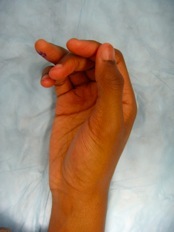
This patient had a cut (laceration) on the palmar aspect of the ring finger. Notice how the finger isn’t flexed (or bent) in the natural position like the others. This is a clue that the flexor tendon has been cut. Even simple punctures/pokes to the palm surface of the finger can result in tendon damage!