The eight bones in the wrist are arranged into a “proximal row,” furthest from the fingers, and a “distal row,” closest to the fingers. The scaphoid, which technically is in the proximal row, is the most commonly fractured bone of these eight in the wrist. If the scaphoid does not heal, it is called a scaphoid non-union, which ultimately can lead to arthritis.
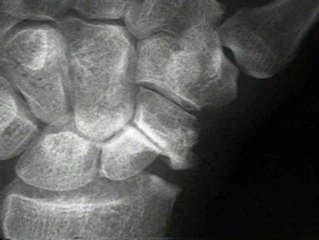 Patients with scaphoid non-union typically have pain along the thumb side of the wrist and a loss of motion. Some non-unions are those that did not heal despite treatment. Most are diagnosed in people who fell onto an outstretched hand and were not treated initially. X-rays are used to confirm these non-unions and to decide what the right treatment is. A non-union that has not progressed to arthritis might be “fixable,” and a CT scan can help show what the bone looks like.
If blood flow has been interrupted and avascular necrosis has occurred (some part of the bone "dies" from bad blood flow to it), the scaphoid might break into pieces; an MRI can be used to look at this.
Treatment depends upon whether the scaphoid can be fixed or not and whether there is arthritis. Your doctor might suggest putting the scaphoid back together and using a bone graft with pins or screws to try to heal the fracture. If this fails or if you already have arthritis, other treatments or surgeries might be suggested. Some people would rather manage their pain than have surgery; splints or braces, anti-inflammatories (including cortisone injections) can help give comfort. Surgeries for this include radial styloidectomy (removing a piece of arthritic bone), partial wrist fusion, or removing the proximal row of wrist bones. If your arthritis is widespread, your doctor might recommend a fusion of he wrist bones.